App Matrix Thinking: Building an Application Ecosystem That Evolves Like Nature
Around 2015, Alibaba proposed its “Middle Platform Strategy”. At that time, the goal was to solve the common problems of repeated construction, high coupling, and limited innovation speed faced by Internet companies. The core logic was simple:
Extract common capabilities into reusable “middle platforms,” so that front-end businesses can innovate more easily and quickly.
Today, as we look back at the evolution of the mobile Internet, this “middle platform mindset” is returning to the spotlight in a new form— namely, App Matrix Architecture.
I. What Is App Matrix Architecture?
“App Matrixing” is not simply about “a company having many apps.” It refers to a system in which multiple apps within a company share core capabilities while expressing differentiated product value, forming an organic ecosystem.
The underlying idea is this:
- Backend middle platforms solve the problem of “service capability reuse”;
- Frontend matrixing solves the problem of “product form reuse.”
In a matrix architecture, multiple apps are no longer isolated entities. Instead, they become:
“Species with shared DNA that evolve for different environments.”
II. From Backend Middle Platforms to Frontend Matrixing: A Shift in Thinking
In the past, middle-platform strategies focused on reusing data, services, and user systems. Today, matrix thinking focuses on reusing product experience, functional logic, and brand expression.
Here’s the difference:
| Dimension | Middle Platform | App Matrix |
|---|---|---|
| Focus Layer | Backend capabilities | Frontend products |
| Goal | Reduce redundant construction | Launch new products faster |
| Manifestation | Unified APIs | Modular product architecture |
| Core Output | Services | Ecosystem |
III. Industry Insights: From ByteDance to AI App Matrices
Let’s look at some real-world examples.
🌐 ByteDance’s Multi-App Matrix
ByteDance’s product line is vast: Douyin (TikTok China), Toutiao, Xigua Video, Tomato Novel, Feishu (Lark), and more. Under the hood, these apps share massive amounts of both backend and frontend capabilities:
- Content distribution engine: recommendation algorithms and feed middle platforms
- Account and user system: unified login, risk control, analytics
- Media rendering layer: audio/video playback, image loading, interactive components
- Internationalization layer: multi-language and regional configurations
As a result, ByteDance can spin up new apps—like Dreamina AI, Doubao, CapCut, etc.—at incredible speed. While each product targets a different audience, they share the same foundational DNA.
In other words, ByteDance’s true strength lies not in any single app, but in its app matrix system.
This is also why ByteDance can confidently involve large numbers of outsourced developers: building a new app is merely reassembling existing modules, not reinventing the wheel.
IV. The Core Elements of Matrix Thinking
Matrixing is not just a technical effort—it’s a systematic design philosophy. Its essence can be understood on three levels:
1️⃣ Capability Layer (Middle Platform)
Extract reusable technical capabilities into shared service layers, such as:
- User system, payment, analytics
- Content rendering, image processing, AI interfaces
- Internationalization, configuration, and gray release systems
These capabilities must be standardized, version-controlled, and easily integrable.
2️⃣ Business Module Layer
Encapsulate domain-specific functions into pluggable modules:
- For an education company: course, question bank, and live-stream modules
- For a content company: feed, media renderer, and comment modules
These modules can be combined as needed—like “product Lego bricks.”
3️⃣ App Shell Layer
Each individual app is a custom assembly and brand expression of these modules. Its job is simply to “decide what appears, where, and in what form.”
V. A Hypothetical Case: Matrixing a Japanese Learning Company
Imagine a startup called NiHong+, focused on Japanese education. As it grows, it wants to launch several niche apps:
- Japanese Learning App: courses + exercises + daily check-ins
- Japanese News App: aggregated Japanese news with vocabulary highlights
- Japanese Finance App: bilingual finance news for professionals
At first glance, these apps seem distinct. But through a matrix lens, they share many common capabilities:
| Shared Capability | Module Name | Reusable Context |
|---|---|---|
| User login/register | user-module | All apps |
| Content fetch & recommendation | content-module | News / Finance / Learning |
| Word highlighting & translation | translation-module | All platforms |
| Learning behavior tracking | analytics-module | Unified metrics & incentives |
| Message & notification system | message-module | Unified communication channel |
(See illustration)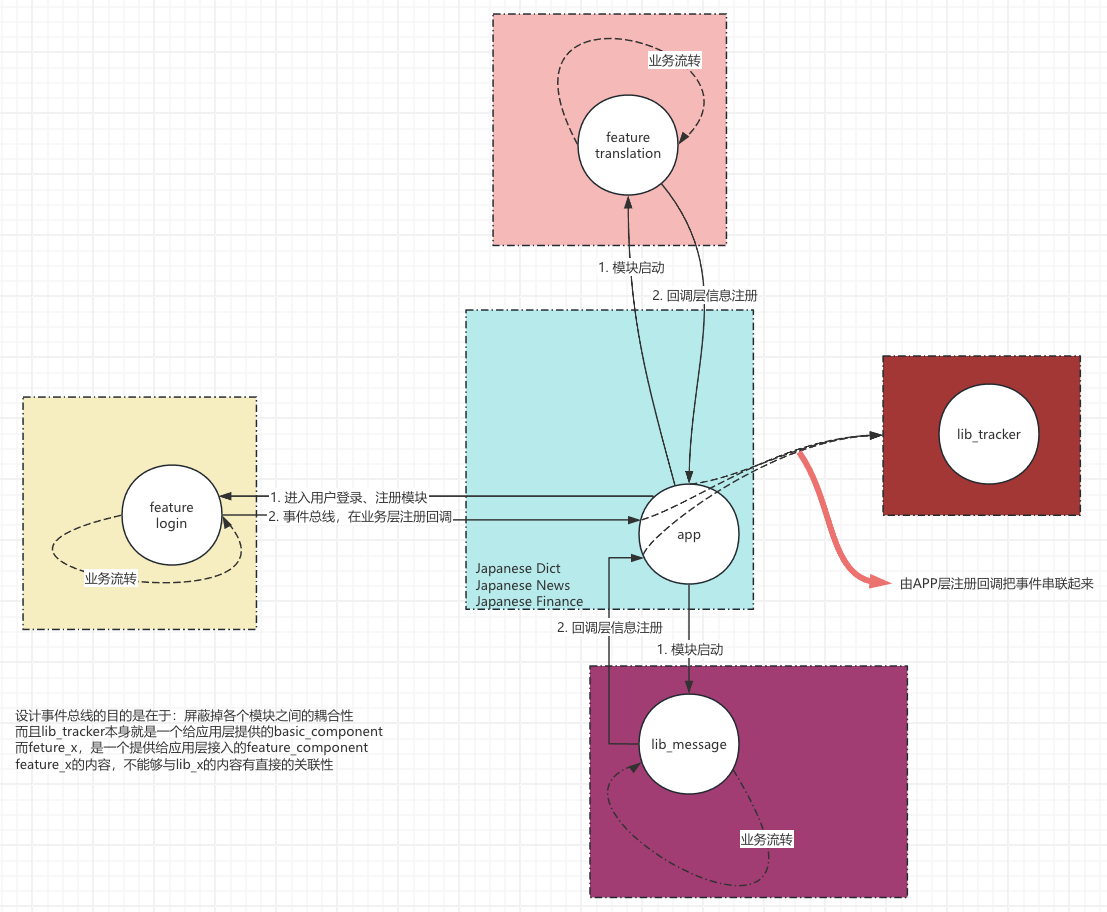
Thus, NiHong+ only needs to maintain one capability base and a set of business modules to rapidly assemble new app forms as needed.
For example:
- Entering the education market → activate course and learning modules
- Doing content distribution → combine content and translation modules
- Targeting B2B market → combine finance + user modules
Each new app launch becomes an act of module assembly and brand extension, not a full-scale rebuild.
VI. The Reuse Principles of Matrix Architecture
To make this architecture sustainable, several key principles must be followed:
Single Responsibility for Each Module Each business module should have clear boundaries and serve one purpose only.
Interface Contracting Modules communicate via well-defined contracts, not direct calls—enabling safe replacement, upgrades, and gray testing.
Configuration-Driven Creation New apps should be built via configuration or metadata, not code duplication.
Independent Brand Layer The app shell should handle only visual, interactive, and marketing expression—not business logic.
Observability Each module should include built-in tracking and data interfaces to measure reuse value.
VII. The Future: From Matrixing to Intelligent Ecosystems
The ultimate form of matrix architecture is a company that can self-evolve. In the era of AI and AIGC, this might look like:
- AI module adaptation: automatically adjusting app structures based on user profiles
- Content middle-platform distribution: multiple apps sharing the same content pool
- Dynamic brand generation: AI-driven customization of UI and branding
- Low-code / no-code app generation: developers assembling apps via standardized interfaces
In this future, a company doesn’t build many apps— it owns an intelligent app ecosystem, where each new form is a recombination of data and capabilities.
🧩 Conclusion
Matrix architecture is not a framework—it’s a systemic worldview. It shifts teams from “building an app” to “building an ecosystem.”
When a company learns to extract commonality, modularize business logic, standardize interfaces, and drive everything by configuration, it gains the ability to replicate success at scale and speed.
The future of competition lies not in individual products, but in how fast ecosystems can evolve. App Matrix Thinking is the technical manifestation of that evolution.